Do residents of this Indian village still enjoy ‘dual citizenship’? |

In the remote hills of Nagaland’s Mon district lies a village that defies the usual understanding of national boundaries. Longwa village sits precisely astride the international border between India and Myanmar. The international boundary, demarcated decades ago, literally cuts through houses, fields, and even the residence of the village chief, locally known as the Angh.Here, where the political border meets ancient tribal lands, geography and culture intertwine to create a distinctive reality: people live, work, trade, and travel as if the border were a nominal line rather than a rigid divide. As a result, Longwa has become synonymous with a concept often described as dual citizenship, although there is no formal legal dual citizenship recognised under Indian or Myanmar law.
What makes Longwa unique?
Longwa’s location is extraordinary. The village lies along the rugged frontier that separates India from Myanmar, and the border actually runs through the village itself. The most famous example is the Angh’s house, one of its rooms falls in Indian territory while the other half lies in Myanmar.The people who live in Longwa belong to the Konyak Naga tribe, one of the major Naga tribes known historically for headhunting, a practice that ended in the 1960s. Today, the Konyaks maintain strong cultural and familial ties across the border, long before modern national boundaries were drawn.
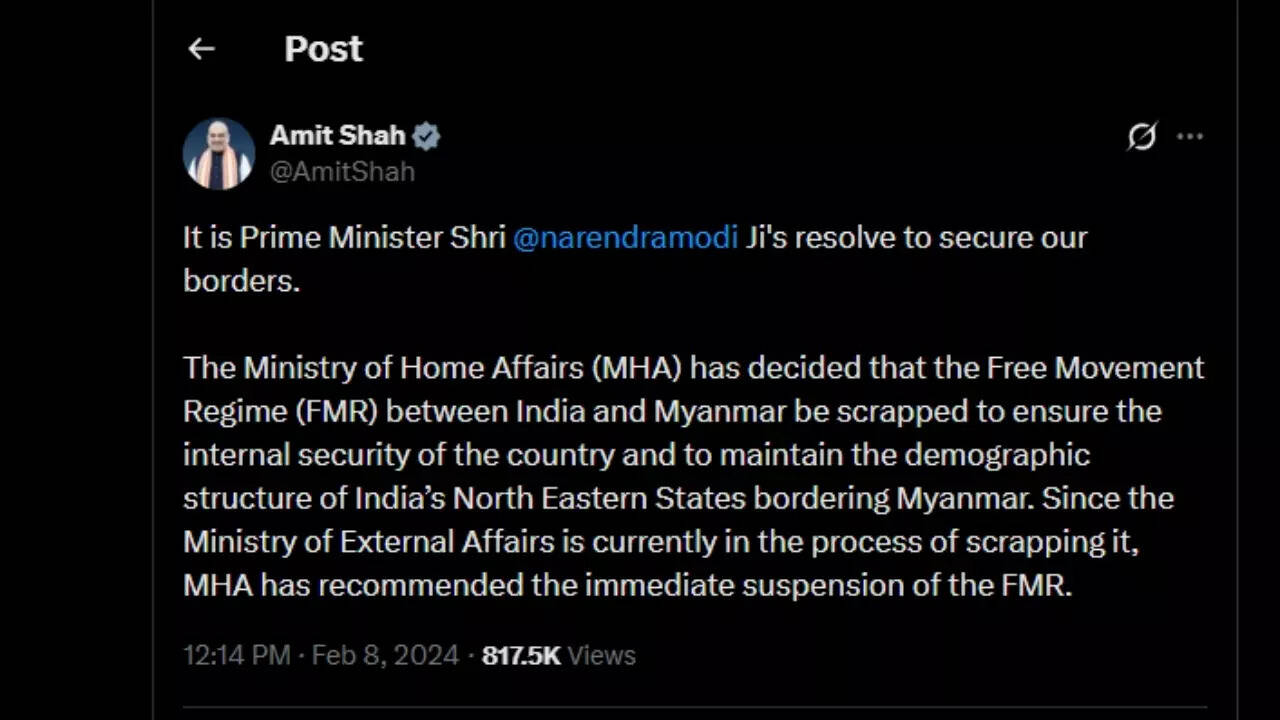
Minister of Home Affairs Amit Shah on X
All about the Dual Citizenship
India’s Constitution does not permit dual citizenship in the legal sense. Indian law strictly allows either Indian citizenship or the citizenship of another country, not both simultaneously. For generations, the residents of Longwa have crossed the India–Myanmar border with little restriction. They moved freely to visit family, attend markets, access education, and take part in cultural life on both sides of the border. This movement was part of what was known as the Free Movement Regime (FMR), which allowed locals to travel across border areas without visas or formal travel documents. However, back in 2024, Minister of Home Affairs Amit Shah announced on X, “It is Prime Minister Shri @narendramodi Ji’s resolve to secure our borders. The Ministry of Home Affairs (MHA) has decided that the Free Movement Regime (FMR) between India and Myanmar be scrapped to ensure the internal security of the country and to maintain the demographic structure of India’s North Eastern States bordering Myanmar. Since the Ministry of External Affairs is currently in the process of scrapping it, MHA has recommended the immediate suspension of the FMR.”So what does this mean? This means that the erstwhile Free Movement Regime between India and Myanmar is now suspended. As of 2026, India has officially decided to scrap the Free Movement Regime with Myanmar, but on the ground it has transitioned into a more controlled and restricted system rather than a total immediate shutdown. Now there is restricted and monitored crossing of the international border. Under the FMR, individuals could move up to several kilometres across the border for social, economic, and cultural activities, an arrangement that acknowledged centuries-old patterns of movement long before the modern boundary existed.
History behind this unique situation of shared borders
Long before colonial boundaries were imposed, the Konyak Nagas and neighbouring tribes lived across this hill country as part of broad tribal networks unfettered by national lines. Colonial treaties, such as the Treaty of Yandabo between British India and Burma in the early 19th century, eventually placed administrative borders through tribal lands. Later, after India’s independence and the emergence of Myanmar as a neighbouring state, the boundary was demarcated officially. Nevertheless, the tribal communities continued their patterns of cross-border life. Many of their lands, homes, and social structures straddled the new boundary.Although people in Longwa may historically have enjoyed practical dual citizenship, stricter enforcement of international boundaries highlights the tensions between traditional cross-border life and modern nation-state policies.In Longwa village, the people may not hold legally recognised dual citizenship, their lived experience reflects a unique blend of tradition, geography, and community that defies the lines drawn on maps.


