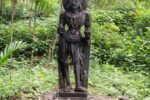
Chandra Parameshwari Devi Idol Form – Iconography
Iconography of Chandra Parameshwari Devi in the Sritattvanidhi
Among the vast pantheon of Devi forms preserved in Hindu
sacred art, Chandra Parameshwari Devi remains one of the least documented yet
quietly significant iconographic forms. She belongs to the extensive list of
Devi manifestations catalogued in the Shritattvanidhi, a nineteenth century
compendium on iconography and iconometry compiled under the patronage of
Krishnaraja Wodeyar III, the Maharaja of Mysore. This work brought together, in
nine sections called nidhis, detailed descriptions and illustrations of forms
of Shiva, Vishnu, Skanda, Ganapati, the Devi, the navagrahas, and the
ashtadikpalas, drawing from earlier textual and ritual traditions rather than
inventing new ones. Chandra Parameshwari appears among a long enumeration of
Devi forms in this tradition, standing as one figure within the wider Shri
Vidya framework of goddess worship.
Iconographic Description
Chandra Parameshwari Devi is described as seated in
lalitasana, the posture of royal ease, upon an ornate couch or throne, a
seating style traditionally reserved for forms of the Devi that embody
sovereignty, comfort, and benevolent authority rather than fierce, standing,
battle ready postures. She is shown with two arms, one holding a sword and the
other a lotus. She wears a tall kirita makuta, the cylindrical crown associated
with regal and majestic deities, and is adorned with rich ornamentation befitting
her status as Parameshwari, the Supreme Ruling Goddess.
Symbolism of the Sword and Lotus
The pairing of sword and lotus in one form is unusual and
carries layered meaning. The sword, or khadga, is a recurring attribute among
Devi forms and represents the cutting away of ignorance, ego, and negative
tendencies. It is the instrument of discrimination, viveka, which severs
illusion from truth. The lotus, padma, held in the same form, represents
purity, spiritual unfolding, and prosperity, remaining unstained even while
rooted in worldly mud. Together, the two attributes present a balance of destructive
and creative forces within a single benevolent figure, she who removes
obstacles while simultaneously nurturing growth and auspiciousness. This dual
symbolism reflects a broader Hindu philosophical idea found across Devi
worship, that the same supreme feminine energy, Shakti, is both the sustainer
and the destroyer, and that spiritual progress requires both the courage to cut
away falsehood and the patience to let purity bloom.
The Crown and Seated Posture
The tall kirita makuta is significant in Hindu sculptural
tradition. It is generally associated with regal, majestic, and benevolent
deities rather than terrifying or ascetic forms, distinguishing Chandra
Parameshwari from more fierce goddesses who are shown with jata makuta or
matted locks. Her seated posture on a couch, rather than standing on a lion,
buffalo demon, or lotus pedestal in a combative stance, further reinforces that
this form emphasizes sovereignty, grace, and stillness rather than active warfare,
even while she bears a weapon.
Regional Variation and the Common Thread
As with many lesser known Devi forms, the exact number of
arms, additional attributes, or ornamentation of Chandra Parameshwari may vary
slightly depending on regional textual traditions, temple practice, or artistic
schools. Hindu iconography has never demanded absolute uniformity across
regions, since living traditions naturally adapt forms to local sensibilities.
However, the sword and lotus combination functions as her identifying
signature, the feature by which she can be recognised regardless of stylistic
variation, much as a trishula identifies Durga or a veena identifies Sarasvati
even when other details differ from region to region.
Importance in Devi Worship
Chandra Parameshwari, though rarely depicted independently
in large scale temple worship compared to more widely known forms such as
Durga, Lakshmi, or Saraswati, holds importance as part of the larger
enumeration of Devi manifestations that together express the idea that the
Supreme Goddess, Parameshwari, the highest ruling power, assumes countless
forms suited to different contexts, temperaments, and modes of worship. Her
presence in the Shritattvanidhi ensures that even lesser known aspects of the
Devi are preserved for scholars, sculptors, and devotees, allowing continuity
of a form that might otherwise have faded from memory. Names containing
Parameshwari generally denote the supreme, all encompassing aspect of the Devi,
positioning each such form as an expression of the same ultimate feminine
principle rather than a wholly separate deity.
Relevance in Modern Art and Sculpture
In contemporary Hindu art, sculpture, and iconographic
scholarship, forms such as Chandra Parameshwari are gaining renewed interest as
artists and researchers revisit historical treatises like the Shritattvanidhi
to recover and reproduce forms that had fallen out of common depiction. Modern
sculptors and painters working in traditional idioms sometimes draw upon such
rare forms to create fresh temple imagery, ritual art, or scholarly
reconstructions, contributing to the preservation of India’s iconographic diversity.
For students of Hindu art history, Chandra Parameshwari also serves as a useful
case study in how attributes such as weapons and flowers are combined to
communicate complex philosophical ideas, destruction of ignorance alongside
cultivation of purity, through a compact visual vocabulary that a devotee can
read at a glance.
Chandra Parameshwari Devi, though sparsely recorded,
exemplifies how Hindu iconographic tradition allows for an almost inexhaustible
expansion of Devi forms, each carrying its own combination of posture,
ornamentation, and attributes while remaining anchored to the same central
philosophy of the Devi as Shakti, the dynamic power underlying creation,
sustenance, and transformation. Her sword and lotus together remind the devotee
that discernment and grace are not opposites but companions on the path toward
the divine.