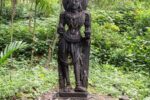
Mrita Sanjeevani Devi: The Rare Iconographic Form of the Life Restoring Devi
Mrita Sanjeevani Devi Idol Form: Iconography, Symbolism and Philosophy
Hindu iconographic tradition is vast, and within it exist
countless forms of Devi that are known only to specific lineages, regions or
Tantric schools. Mrita Sanjeevani Devi is one such rare and lesser documented
form. Her name itself carries her essence, Mrita meaning the dead, and
Sanjeevani meaning that which restores life or brings back vitality. She is
regarded as an embodiment of the power that overcomes death, a concept deeply
rooted in Hindu belief regarding the impermanence of the body and the permanence
of the atman.
Unlike widely worshipped forms such as Durga or Lakshmi,
Mrita Sanjeevani Devi does not appear prominently in the major Puranas. Her
description survives instead through Tantric compendiums, regional dhyana
slokas and ritual manuals, where such rare forms are preserved precisely
because they serve specific ritual purposes, in this case, the warding off of
untimely death and the restoration of health and vitality.
Iconographic Form and Description
According to the description preserved in Tantric sources,
Mrita Sanjeevani Devi is depicted seated in lalitasana, the posture of royal
ease where one leg is folded upon the seat and the other rests downward, a
posture commonly associated with goddesses who combine grace with authority.
She is shown with eight arms, a number that in Hindu
iconography often signifies command over the eight directions or the
completeness of divine power extending in all directions of existence. In her
hands she holds the ankusha, khadga, trishula, sarpa, gada and pasha, while two
of her hands display the Varada and Abhaya mudras.
She wears a kirita makuta, the tall crown associated with
sovereign and powerful deities, along with the ornaments customary to Devi
forms, including necklaces, armlets and anklets, marking her as a queenly and
commanding presence rather than a purely fierce or purely benevolent one.
Symbolism of Her Attributes
Each object in the hands of a Devi is never decorative
alone, it is a teaching in itself.
The ankusha, or the elephant goad, represents control, the
power to direct and restrain the mind and the senses. The khadga, the sword,
signifies the cutting away of ignorance and the illusion that binds the soul to
fear of death. The trishula, the trident, represents the three gunas, sattva,
rajas and tamas, held in balance by the Devi. The sarpa, or serpent, is closely
tied to the theme of Mrita Sanjeevani herself, since the serpent in Hindu
thought sheds its skin and is reborn, symbolising the very renewal of life that
this Devi bestows. The gada, or mace, represents strength and steadfastness,
while the pasha, the noose, represents the binding and controlling of negative
forces, disease and untimely death itself.
Mudras: Varada and Abhaya
The Varada mudra, the boon giving gesture, assures the
devotee of blessings and fulfilment, while the Abhaya mudra, the gesture of
fearlessness, removes fear, particularly the fear of death that is central to
her worship. Together these two mudras summarise her purpose, she takes away
fear and grants the boon of continued life and wellbeing.
Seat, Crown and Ornamentation
The lalitasana posture is significant because it is neither
a posture of war nor one of complete stillness, it represents readiness
combined with composure. The kirita makuta, the crown, elevates her status to
that of a sovereign Devi, one who governs over life and death rather than one
who merely intercedes in it.
Textual and Ritual Context
The worship of Mrita Sanjeevani is closely associated with
the tradition of the Mrita Sanjeevani mantra and the Mrita Sanjeevana Kavacham,
a protective armour text recited for the prevention of untimely death. The
kavacham opens by describing itself, in its own words, as the armour of victory
over death, to be chanted after worship of Gowrisha, the Devi united with Shiva
as the conqueror of death. While this kavacham centres its praise on Shiva as
Mrityunjaya, the underlying philosophy, that a focused sadhana can overturn
even the decree of death, is the same philosophy that gives rise to the
independent iconographic form of Mrita Sanjeevani Devi in the Shakta Tantric
tradition.
This theme is not unfamiliar to Hindu scripture more
broadly. The Rig Veda itself preserves the Mrityunjaya mantra, addressed to
Rudra, which prays for release from the bond of death just as the cucumber is
freed from its stem, and not for freedom from immortality itself. This vedic
seed idea, of loosening the hold of death while honouring the inevitability of
the body, underlies the later Tantric elaboration of a Devi form whose very
name proclaims her power over death.
Regional Variation and the Constant Core
As is common with rarely depicted forms, the number of arms,
the exact attributes held, and even certain ornamental details of Mrita
Sanjeevani Devi can differ from one regional tradition or Tantric text to
another. Some descriptions may reduce or alter the weapons held, or vary the
crown and ornamentation according to local sculptural custom. Yet across these
variations, the serpent as a symbol of renewed life, the combination of Varada
and Abhaya mudras, and her essential identity as a Devi who restores life from
death remain the constant thread that allows her to be recognised regardless of
regional interpretation.
Philosophical Significance
In Hindu thought, death is not viewed as an end but as a
transition, and the fear of death is considered one of the greatest obstacles
on the spiritual path. A Devi form built entirely around the theme of
overturning death allows the devotee to approach this fear directly, not
through denial, but through a form that combines fierce capability, in her
weapons, with maternal assurance, in her mudras. This balance mirrors a wider
Shakta philosophy in which the Devi is simultaneously the destroyer of obstacles
and the nurturing sustainer of life.
Relevance in Modern Art and Practice
In contemporary Hindu art and sculpture, forms like Mrita
Sanjeevani Devi are rarely commissioned, largely because her worship remains
confined to specific Tantric and healing oriented traditions rather than
popular practice. However, interest in reviving rare iconographic forms has
grown among traditional sculptors, temple artists and scholars documenting
regional Devi worship. Depicting her today, whether in sculpture, painting or
digital art, offers an opportunity to preserve a fading strand of Shakta iconography,
and to present death not as something to be feared in art, but as something
that can be artistically expressed as being conquered through devotion,
discipline and the grace of the Devi.
Mrita Sanjeevani Devi remains one of the more obscure yet
philosophically rich forms within Hindu Devi worship. Seated in lalitasana,
crowned as a sovereign, armed with symbols of control and renewal, and offering
both fearlessness and blessing through her mudras, she stands as a sculptural
embodiment of a very old Hindu conviction, that life, rightly understood and
rightly worshipped, can always be called back from the edge of death.