Nirrti Dikpalaka Idol Form – Iconography – Decoding the South-Western Guardian in Hindu Sculpture
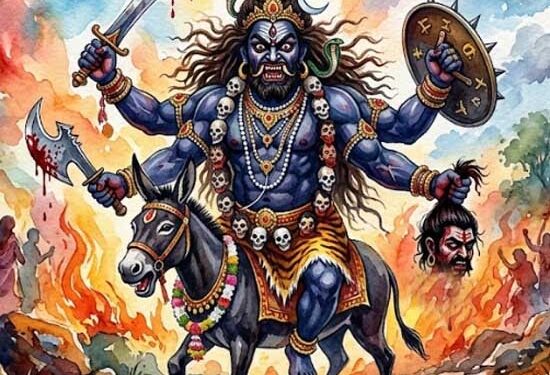
Iconography of Nirrti: Sculptural Forms, Symbolism and Vahana Traditions – The Fierce Guardian of the South-West and Monarch of Demons
In the Hindu system of directional guardianship, the
universe is protected not by one power alone but by eight Dikpalakas, each
presiding over a cardinal or intercardinal point. Nirrti is assigned the
south-western quarter, a direction traditionally associated with instability,
decay and the dissolution of order. As the guardian of this quarter, Nirrti is
not worshipped as a benevolent protector in the ordinary sense, but is
propitiated as a formidable power who must be honoured so that the forces of chaos
he embodies remain contained rather than unleashed. He is titled raksasesvara,
the sovereign of the raksasas, placing him at the head of the demonic hierarchy
in the cosmic order maintained by the Dikpalakas.
The Kalika Purana Description
The Kalika Purana presents Nirrti in a two-armed form. His
complexion is described as dark, his body immense, and his hair matted in the
manner of an ascetic yet terrifying figure. He bears a sword in his right hand
and a shield in his left, the classic weapons of a warrior-guardian rather than
a peaceful deity. Despite carrying every ornament befitting a divine figure,
his countenance is deliberately fearsome: eyes that are crooked and cruel, and
fangs that protrude with ferocity. This combination of ornamentation and terror
is significant in Hindu sculptural philosophy. A guardian deity is often
depicted as both regal and dreadful at once, because his role is to frighten
away disorder while still belonging to the divine order himself. Ornamentation
signals his legitimate place among the gods; his terrifying features signal his
function as a deterrent to evil.

The Four-Armed Form in Rupa-mandana
The Rupa-mandana, a text of Shilpa Shastra dealing with
iconometry and image-making, gives Nirrti a more elaborate four-armed form.
Here he carries a sword, a shield, a chopper, and the severed head of an enemy.
The severed head is a common iconographic motif across fierce Hindu deities,
symbolising the destruction of ego, ignorance or hostile forces. In Nirrti’s
case, holding the trophy of a defeated enemy reinforces his identity as a
martial guardian who actively subdues the very chaos and misfortune his name
represents. The additional pair of arms in this form also reflects a broader
tendency in Hindu iconography where increased divine potency is expressed
through additional limbs, each holding an implement that expands the deity’s
capacity to protect, punish or destroy.
The Question of Vahana: Multiple Textual Traditions
Few aspects of Nirrti’s iconography vary as much across
texts as his vehicle, or vahana. The Kalika Purana and the Vishnudharmottara
Purana describe him as kharastha, mounted upon a donkey, an animal
traditionally linked with inauspiciousness and the south-western direction in
Vastu Shastra. The Amsumadbhedagama offers three alternatives: a bhadra-pitha
or ceremonial seat, a lion, or a man functioning as his mount, termed
nara-vahana. The Suprabhedagama settles on the lion alone, aligning Nirrti with
the majesty and ferocity associated elsewhere with Devi in her role as
vanquisher of demons. The Shilparatna returns to the human vahana, while the
Rupamandana assigns him a dog, an animal historically connected in some
traditions with liminal spaces, death and the guarding of thresholds. The
Karanagama goes furthest in emphasising his association with mortality by
placing him upon a corpse, shavasana, a seat that visually and symbolically
ties him to the cremation ground and the impermanence of the physical body.
This diversity is not a contradiction to be resolved but a
reflection of how Agamic and Puranic literature developed regionally and across
sectarian schools, each emphasising a different facet of Nirrti’s character:
his connection to inauspicious animals, his martial ferocity, his liminal
status between gods and demons, or his intimate relationship with death.
Symbolism and Philosophical Significance
Nirrti’s south-western position is philosophically loaded.
In Vastu Shastra, the south-west is considered the direction of weight,
stability and the subduing of negative energy; heavy structures and storage
spaces are traditionally placed here to anchor a building against disturbance.
Nirrti’s fearsome form and his association with donkeys, corpses and dogs
mirror this architectural logic: he is placed where instability is most likely
to arise, precisely so that his terrifying presence can hold it in check. His
identity as monarch of demons further reinforces this idea. Rather than being
external to the raksasas he governs, Nirrti is positioned as their sovereign,
meaning that disorder itself is given a ruler who is answerable, in the cosmic
hierarchy, to the greater order presided over by Ishvara. This is a recurring
theme in Hindu theology: even chaos, decay and fear are not left ownerless but
are placed under a guardian who keeps them oriented toward cosmic balance
rather than unchecked destruction.
Relevance in Sculpture and Temple Art
In temple architecture, images of the Dikpalakas, including
Nirrti, are traditionally installed on the exterior walls or ceiling panels
corresponding to their respective directions, a practice still followed in
traditional temple construction and restoration today. Sculptors working within
the Shilpa Shastra tradition continue to consult texts such as the Rupa-mandana
and various Agamas when commissioned to carve or cast Dikpalaka sets for
temples, particularly in South Indian stone and bronze traditions. In
contemporary art and design, Nirrti’s iconography, with its dramatic weaponry,
fierce expression and unusual vahana options, offers artists a rich visual
vocabulary distinct from the more commonly depicted forms of Indra, Varuna or
Kubera. His imagery is increasingly referenced in scholarly restorations of
temple facades and in academic discussions of regional iconographic variation,
serving as a reminder that Hindu sculptural tradition was never monolithic but
developed through multiple, sometimes divergent, textual streams that sculptors
and priests reconciled according to regional custom and available Agamic
authority.
Nirrti stands as one of the more visually striking and
textually varied figures among the Ashta-Dikpalakas. Whether shown two-armed
with sword and shield in the Kalika Purana, or four-armed bearing a severed
head in the Rupa-mandana, and whether seated on a donkey, a lion, a man, a dog
or a corpse, his form consistently communicates the same underlying philosophy:
that the guardianship of order sometimes requires a deity who is himself
terrifying, dark and closely bound to decay, death and the demonic. His
continued presence in temple sculpture and Shilpa Shastra literature affirms
his enduring, if lesser-discussed, place within the architectural and
devotional fabric of Hindu sacred art.