Small Axe – Tanka of Hindu sculptures
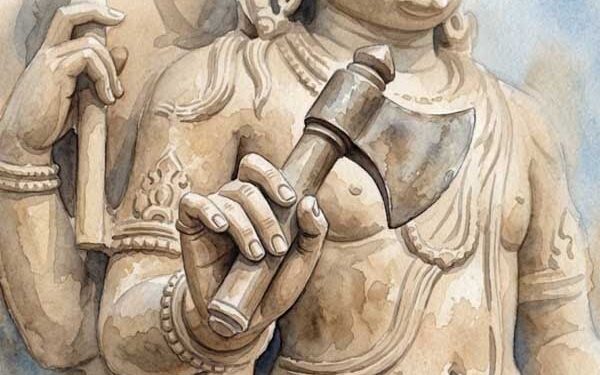
Among the many hand-held emblems, or ayudhas, found
in Hindu sculptural art, the tanka occupies a modest yet meaningful
place. Known in Sanskrit as tanka, this small axe or hatchet-like
implement is closely related to the parasu, the larger battle-axe, but
is distinguished by its size, form, and function within iconographic tradition.
It belongs to the broader category of chopping and cutting instruments, and is
generally classified as a secondary attribute rather than a primary weapon of
divine power.
Origin and Classification
In the classical texts on iconometry and image-making,
collectively known as the Shilpa Shastras and Agamas, every object placed in
the hands of a deity carries deliberate meaning. The tanka finds its
origins as a craftsman’s tool, essentially a mason’s or sculptor’s chisel used
for carving stone. Over time, this everyday implement was absorbed into the
iconographic vocabulary of temple art, appearing as a subsidiary emblem in the
hands of certain deities, most notably in select forms associated with Shiva.
Form and Depiction
Sculptors rendered the tanka with a short handle and
a compact, wedge-shaped blade, generally broader at the cutting edge and
tapering toward the socket where it meets the handle. Its profile is sturdy,
balanced, and unpretentious, reflecting its practical origins. In bronze images
and stone reliefs, the tanka is shown held firmly by the handle, with
the blade turned outward or slightly upward. Notably, it is never depicted in
the act of striking; it remains a static, symbolic presence rather than an
active weapon of combat, distinguishing it clearly from ayudhas like the parasu
or khadga that are shown mid-action in fierce forms.
Symbolism and Meaning
As a tool of shaping and carving, the tanka carries
symbolic overtones of creation through removal, the idea that form emerges when
the unnecessary is chipped away. In the hands of a deity, it can be read as an
emblem of refinement, of cutting away ignorance, ego, or impurity to reveal the
essential self, echoing the broader Shaiva philosophy in which Shiva is both
destroyer and revealer of truth. Because it is a secondary attribute, its
presence often accompanies other principal ayudhas, reinforcing rather than
defining the deity’s central character.
Occurrence in Iconographic Contexts
The tanka is not a universal attribute; it appears
selectively, occurring in particular regional and temporal sculptural
traditions and with certain specific forms of Shiva. Texts such as the Amshumadbhedagama
and the Vishnudharmottara Purana, which lay down detailed prescriptions
for image-making, discuss the wide array of ayudhas, including tools like the tanka,
that may be assigned to multi-armed forms depending on the deity’s aspect being
portrayed. Its inclusion in a particular murti often reflects local sculptural
convention as much as scriptural prescription.
Importance in Sculptural Practice
For the traditional sculptor, or shilpi, the tanka
held a dual identity: it was both the literal chisel used to bring the stone
image into being and, at times, a symbolic object placed within that very
image. This duality underscores a unique feature of Hindu artistic philosophy,
where the instrument of creation itself becomes part of the sacred vocabulary
of the creation. The shilpi’s own craft is thus quietly honoured within
the very icon it produces.
Relevance in Modern Art
In contemporary art and design inspired by Hindu
iconography, the tanka rarely stands alone but is valuable to art
historians, restorers, and iconographers as a precise identifying marker when
classifying regional bronzes and stone sculptures. Modern replicas, museum
cataloguing, and academic study of temple art continue to reference such minor
ayudhas to correctly date and attribute sculptural works, making the tanka
a small but scholarly significant detail in the larger study of Hindu sacred
art.
Though modest in size, the tanka reflects the depth
and precision of Hindu iconographic tradition, where even a small chisel-axe
carries layered meaning, connecting the crafts of the sculptor to the symbolism
of the divine. It stands as a reminder that in Hindu artistic philosophy, no attribute
is incidental, every object placed in a deity’s hand is a considered part of a
larger sacred language.