The Kanthi: The Throat Ornament of Hindu Sculptural Tradition
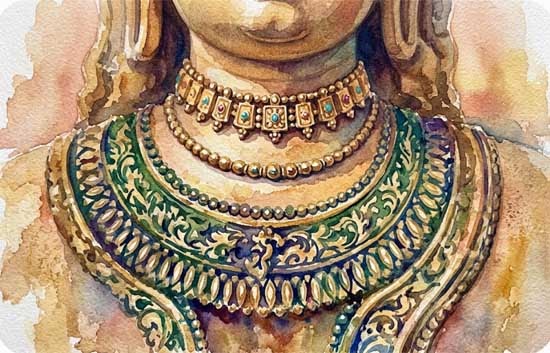
Kanthi in Hindu Iconography: The Uppermost Layer of Divine Adornment
Among the many categories of ornamentation described in the
shilpa shastras, the kanthi occupies a distinct and significant place. Worn
snugly at the base of the throat, the kanthi is a short neck ornament that
forms the uppermost layer in a composed sequence of neck jewellery on divine
and royal images. Unlike the longer necklaces that fall over the chest, the
kanthi hugs the throat closely, acting as a visual bridge between the face and
the torso of the sculpted figure. It is broader in scope than the grivaveyaka,
another throat ornament category, since kanthi encompasses a wide range of
forms including bead strings, collar-like bands, and linked decorative plaques.
Textual Foundations
The Manasara, one of the most authoritative treatises on
Hindu architecture and iconometry, places the kanthi among the grivabharanas,
the class of neck ornaments. It specifies that the kanthi should be
proportionate to the circumference of the throat, ensuring that the ornament
harmonizes with the natural anatomy of the figure rather than overwhelming it.
This insistence on proportion reflects the larger philosophy of shilpa shastra,
where every ornament, gesture, and limb is governed by measured ratios called
tala and angula, so that the divine form remains both aesthetically pleasing
and spiritually potent.
The Shilpa Ratna similarly recognizes the kanthi as a
standard neck ornament suitable for both divine and royal figures, while
allowing considerable freedom in its form, ornamentation, and construction.
This flexibility permitted regional schools of sculpture to interpret the
kanthi differently, giving rise to varied bead patterns, floral motifs, and
metalwork styles across different temple traditions.
The Shritattvanidhi, a later compendium on iconography,
describes the kanthi as a short neck ornament positioned above longer
necklaces, often composed of beads, plaques, or linked decorative units. This
layered arrangement is not merely decorative; it follows a conceptual hierarchy
in which the ornaments closest to the throat are considered the most intimate,
framing the face and drawing the devotee’s gaze upward toward the countenance
of the deity.
Symbolism and Meaning
In Hindu sculptural philosophy, ornamentation is never
incidental. Ornaments, or alamkara, are understood as expressions of
auspiciousness, prosperity, and the completeness of divine beauty. The throat
itself carries deep symbolic weight in Hindu thought, being associated with the
vishuddha chakra, the center of speech, purity, and expression. An ornament
placed at this juncture, therefore, can be read as marking the sacred passage
between the inner being and outward manifestation, between thought and word.
The kanthi, sitting precisely at this point, visually emphasizes the dignity
and composure of the divine or royal figure it adorns.
The layering of the kanthi above longer necklaces such as
the haara also reflects a broader Hindu aesthetic principle: that beauty is
built in graduated stages, moving from the intimate and close-fitting to the
expansive and flowing. This progression mirrors ideas found in temple
architecture itself, where forms rise from a compact base to an elaborate
crown, echoing the movement from the mundane to the transcendent.
The Kanthi in Bronze Iconography
In the bronze traditions of South India, particularly those
associated with Chola and later Vijayanagara casting, the kanthi is rendered
with remarkable delicacy. It frequently appears as a short necklace encircling
the neck, serving as the uppermost layer in a sequence that may include a
channavira, a long haara, and a udarabandha lower down. Bronze images of
Bhagavan Vishnu, Devi Parvati, and various forms of Shiva often display the
kanthi with fine bead work or petal-like segments, capturing light and shadow
in a way that stone carving cannot always replicate. The kanthi in these
bronzes helps unify the composition, ensuring that the eye moves smoothly from
the crown and face down through the layered ornaments to the chest.
Relevance in Modern Art and Design
Today, the kanthi continues to inspire contemporary
jewellery design, temple art restoration, and classical dance costuming,
particularly in Bharatanatyam and Kuchipudi, where performers wear stylized
kanthi-type chokers to evoke the aesthetic of temple sculpture. Modern silpis
and bronze casters engaged in traditional icon-making continue to follow the
proportional guidelines of the Manasara, ensuring continuity between ancient
prescriptive texts and present-day devotional art. In this way, the kanthi remains
not a relic of the past but a living element of an unbroken artistic and
spiritual tradition.
The kanthi exemplifies how Hindu sculptural tradition treats
ornamentation as inseparable from meaning. Governed by textual precision yet
open to artistic variation, it stands as a small but essential detail that
carries forward centuries of philosophy, proportion, and devotion in a single,
elegant band around the throat.


