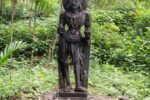
Vashyamukhi Devi – Idol Form – Symbolism – Meaning
Vashyamukhi Devi: Iconography, Symbolism and the Power of Attraction in Srividya
Within the vast and layered universe of Shakta iconography,
certain forms of the Devi remain known only to initiated practitioners and
specialised textual traditions rather than to popular worship. Vasya Mukhi Devi
is one such form. Her name itself is instructive: Vashya relates to attraction,
control and the bringing of the mind under benevolent influence, while Mukhi
indicates the face or the presiding aspect through which this power expresses
itself. She is not widely sculpted in temple complexes in the manner of Durga
or Lakshmi, yet she occupies a distinct place among the Devi forms associated
with the Srividya tradition, where the Goddess manifests in countless
specialised aspects, each carrying a particular ritual function.
The Iconographic Form
Vashyamukhi Devi is described as standing in the dynamic
posture of an archer, drawing an arrow from a bow fashioned of sugarcane, known
in Sanskrit as Ikshu Dhanush. She is two armed, carries a quiver of arrows upon
her back, and is adorned with an elaborate coiffure and ornaments befitting a
Devi of beauty and command. This standing, action-oriented posture separates
her from the more commonly seated or seductive forms of Devi associated with
desire, giving her an assertive, almost martial character even while her
weapons are made of the softest materials found in nature.
Symbolism of the Sugarcane Bow and Flower Weapons
The sugarcane bow is among the most evocative symbols in
Shakta iconography. Sugarcane possesses a hard outer rind concealing intense
sweetness within, and this duality is used repeatedly across scripture to
represent the mind itself, disciplined on the outside, blissful within. The
Lalita Sahasranama, in its description of Lalita Tripurasundari, names her
Manorupekshu Kodanda, meaning she who wields a sugarcane bow that is the very
form of the mind, and Panchatanmatra Sayaka, she who holds five arrows representing
the five subtle elements of perception. The same weapon, in the hands of
Kameshwari, one of the fifteen Nitya Devis described in the Tantraraja Tantra,
is paired with five flowering arrows individually named Longing, Maddening,
Kindling, Enchanting and Wasting, each a stage in the psychology of desire.
Vashyamukhi Devi belongs to this same conceptual family.
Where Kameshwari and Lalita are generally shown in a poised, seated stance,
holding the bow rather than drawing it, Vashyamukhi Devi is caught in the very
act of release, suggesting immediacy and directed intent. The arrow in flight
becomes a metaphor for the swift working of subtle, attractive power, drawing
beings, minds and circumstances toward auspiciousness rather than harm.
Relation to Kamadeva and Rati
The user’s observation comparing her to Kamadeva and Rati is
apt. Kamadeva, too, is armed with a sugarcane bow strung with bees and five
flower tipped arrows aimed respectively at exciting the heart, provoking
longing, unsettling the mind, causing infatuation of the eyes, and total
absorption in love. Rati, his consort, embodies the fulfilment of that longing.
Vashyamukhi Devi appears to function as a Shakta parallel, a feminine,
independent embodiment of attraction that does not depend upon a male consort for
completion, consistent with the Srivdiya emphasis on Devi as the primary, self
sufficient reality, of which even Kama and Shiva are said to be manifestations,
as reflected in the Lalitopakhyana section of the Brahmanda Purana.
Regional Variation and Philosophical Import
As with many specialised tantric forms, the exact number of
arms, ornaments, and accompanying attributes of Vashyamukhi Devi vary by region
and lineage. What remains constant across all descriptions is the sugarcane bow
and the act of shooting, the common factor that allows her to be recognised
regardless of local variation. Philosophically, she represents Vashikarana in
its higher, spiritual sense, not coercive control but the natural magnetism of
a purified consciousness, the capacity of the disciplined mind to draw grace,
harmony and right circumstance toward itself.
Relevance in Modern Art
Contemporary tantric and devotional artists increasingly
explore lesser known Nitya and regional Devi forms like Vashyamukhi as a way of
expanding the visual vocabulary of Goddess worship beyond the standard Durga or
Kali imagery. Her dynamic archer’s pose, sweet yet formidable weapon, and
independent stance make her a compelling subject for miniature painting, yantra
design and modern reinterpretations of Devi as empowered, self directed
feminine energy.