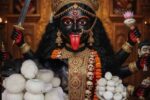
Goddess or Shakti of 9th Avarana – the Bindu Central Point of Mahameru – Sri Chakra
The Bindu: Lalita Mahatripurasundari and the Supreme Secret of the Ninth Avarana – At the Crown of Meru: The Goddess of the Ninth Avarana and the Mystery of the Bindu
The Mahameru is the three-dimensional, pyramidal
manifestation of the Sri Chakra, one of the most revered and complex yantra
forms in the Shakta Tantric tradition. Where the Sri Chakra is drawn as a
two-dimensional diagram of concentric enclosures, interlocking triangles, and a
central point, the Mahameru rises upward as a tiered mountain of geometry, with
each enclosure or avarana stacked upon the next in ascending order of spiritual
refinement. The devotee who meditates upon or circumambulates the Mahameru is
understood to be journeying inward and upward simultaneously, moving from the
outermost enclosure toward the absolute centre, shedding the outer layers of
phenomenal existence with each step.
There are nine avaranas in the Sri Chakra, each governed by
a presiding deity, a distinct group of Shaktis, a specific name, and a precise
geometric form. The journey through all nine is the journey of the soul from
multiplicity back to unity, from the world of nama and rupa, name and form, to
the formless ground of pure consciousness.
The Ninth Avarana: Sarva Ananda Maya Chakra
The ninth and final avarana is called the Sarva Ananda Maya
Chakra, the enclosure that is made entirely of bliss. It corresponds to the
Bindu, the single luminous point at the geometric and spiritual summit of the
entire structure. In the Mahameru, this is literally the apex of the pyramid,
the peak of the sacred mountain, that single point where all lines of geometry,
all threads of worship, and all streams of consciousness converge and dissolve.
The Lalita Sahasranama describes the Devi as Sarvananda
Maya, one whose very nature is all-pervading bliss. The Soundaryalahari of Adi
Shankaracharya opens with the celebrated verse:
“Shivah shaktya yukto yadi bhavati shaktah prabhavitum,
na ched evam devo na khalu kushalah spanditum api” (Soundaryalahari, verse
1)
meaning that Shiva, only when united with Shakti, has the
power to create; without her, he cannot even stir. This verse is not mere
poetic flourish. It is the theological foundation of the Bindu itself, where
Shiva and Shakti are eternally united as Kameshwara and Kameshwari, the
inseparable dyad at the heart of all existence.
The Presiding Goddess: Lalita Mahatripurasundari
The Chakra Swamini of this supreme enclosure is Sri Sri
Lalita Parabhattarika Sarvananda Maya Chakra Swamini, a title that identifies
the Goddess not merely as a deity but as the sovereign ruler of the
bliss-filled enclosure, the supreme empress whose very sovereignty is bliss
itself. She is more universally known as Lalita Mahatripurasundari, the Great
Beautiful One of the Three Cities, or simply as Tripurasundari, the most
beautiful being across the three realms of creation, preservation, and dissolution.
Her iconography is precise and laden with deep symbolic
meaning. She is four-armed, seated upon the Sripitha, the sacred throne that is
itself a cosmological structure representing the combined presence of Brahma,
Vishnu, Rudra, and Ishwara as the four legs, with Sadashiva as the seat itself.
She holds in her hands the Ikshu Dhanus, the bow of sugarcane, which represents
the mind saturated with the sweetness of desire directed toward liberation
rather than bondage. Her five flower arrows, the Pancha Pushpa Bana, correspond
to the five tanmatras or subtle sense essences, namely sound, touch, form,
taste, and smell, indicating that the entire sensory universe is her weapon,
deployed in service of awakening rather than entrapment.
The Pasha, the noose, represents the binding power of maya
and the capacity of the Goddess to hold souls in loving captivity within the
realm of experience until they are ready for liberation. The Ankusha, the goad,
represents her power to direct, discipline, and ultimately drive the individual
consciousness toward its highest destination. She is three-eyed, with the third
eye representing transcendent wisdom that sees beyond the duality of the other
two. She is crowned, for she is the sovereign of sovereigns, and she is seated
in Srichakrasana, enthroned upon the Sri Chakra itself as both its ruler and
its living essence.
The Yogini of the Bindu: Para, Parapara, and Rahasya
The Yogini associated with the ninth avarana is named in
various Tantric lineages as Para-Parapara-Rahasya Yogini. The name itself is a
philosophical statement. Para denotes the transcendent, the supreme beyond
conception. Parapara denotes the level between the transcendent and the
immanent. Rahasya means secret, that which is concealed within and cannot be
transmitted through ordinary instruction. In certain lineages, the Yogini of
this Bindu is simply identified as Rajarajeshwari or Mahatripurasundari herself,
indicating that at this final point, the Yogini and the presiding Goddess are
no longer distinguishable. The guardian and the guarded are one.
Shiva-Shakti: The Union at the Bindu
Unlike all the other eight avaranas, the ninth does not
contain a further subdivision of Devis. There is no array, no grouping, no
multiplicity. The Bindu is, by its geometric and metaphysical definition,
without dimension. It is the point before expansion, the silence before sound,
the stillness before the first vibration of creation. The Devi Bhagavata Purana
and the Tripura Rahasya both describe how all of manifest existence unfolds
outward from this single point of Shakti consciousness, and how the entire
practice of Sri Vidya Upasana is designed to reverse that outward flow, drawing
the practitioner back inward toward this origin.
Here, Kameshwara and Kameshwari, Shiva and Shakti as
absolute lord and lady of desire transmuted into divine will, sit in eternal
union. This is the Maithuna of the metaphysical order, not a physical union but
the primordial non-dual state in which masculine consciousness and feminine
power are revealed as two aspects of one indivisible reality. The Kamakala
Vilasa describes the Bindu as the seat of this supreme union, the place where
Iccha Shakti, will, Jnana Shakti, knowledge, and Kriya Shakti, action, converge
into one undivided luminosity.
Significance for the Devotee and the Modern Seeker
The worship of Lalita Mahatripurasundari at the Bindu is not
merely ritual. It is an invitation to encounter one’s own consciousness at its
most fundamental layer. In an age of fragmentation, information overload, and
dispersed attention, the symbolism of the Bindu carries immediate relevance.
The entire Sri Chakra is an outer-to-inner map, and its message is that reality
has a centre, that consciousness has a source, and that beauty, wisdom, and
bliss are not achievements to be acquired from outside but recognitions to be
uncovered within.
The practitioner of Sri Vidya understands that to reach the
Bindu is not to leave the world behind but to see the world as it truly is,
radiant with the consciousness of Lalita, beautiful in its entirety, and
saturated from root to apex with the bliss that is her very nature.