Khichuri Bhog Offered On Kojagari Lakshmi Puja – Symbolism – Story
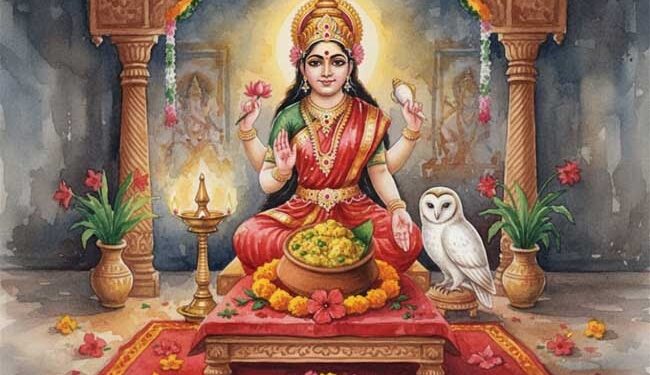
Kojagari Lakshmi Puja is famous for its food offerings and delicacies.
Among the grand spread, one dish is almost indispensable — the “bhoger
khichuri” (offering of khichuri)! Many believe that the worship of Goddess
Lakshmi feels incomplete without offering khichuri. Let us explore the symbolism
and the story associated with it.
Why is bhoger khichuri essential?
Offering khichuri during Kojagari Lakshmi Puja is an age-old
tradition, deeply rooted in Bengali households. Though the items in the
offering may vary slightly by region — for instance, some offer ilish (hilsa
fish), while others prepare a completely vegetarian feast — khichuri holds a
special place. It is not merely a simple dish, but one of profound cultural and
spiritual significance.
Bhoger khichuri is not just a culinary custom. It is a sweet
symbol of prosperity, unity, and purity — a tradition that has become
inseparable from the worship of Goddess Lakshmi in Bengali homes for
generations.
Symbol of Wealth and Prosperity
Lakshmi is the goddess of wealth, grain, and abundance. Khichuri
is made mainly from rice and lentils — rice being the symbol of grain, the
foundation of life. When mixed with lentils and vegetables, this wholesome dish
signifies prosperity and the arrival of the harvest season. Offering it is
believed to please Goddess Lakshmi and invoke her blessings for wealth, grain,
and overall well-being in the household.
Simplicity and Purity
The offerings made to Lakshmi are sattvik in nature — that
is, they do not contain onion or garlic. Khichuri is a simple yet nutritious
dish that embodies purity and devotion, making it a perfect offering to the
goddess.
Symbol of Unity
Made by combining rice, lentils, and various vegetables, khichuri
also represents unity and harmony — a blend of different elements coming
together as one.
The Story Behind Khichuri Bhog
There is a popular legend from the Ramayana that explains
why khichuri is offered during Lakshmi Puja.
According to mythology, after defeating Ravana on Dashami
(the day of Dussehra), Bhagavan Sri Rama returned to Ayodhya with Sita, around
the time of Diwali. However, rumors began to spread in Ayodhya about Sita’s
purity. It is said that on the day of Lakshmi Puja, while Sita was chatting
with her companions and drawing a picture of Ravana, Lord Rama suddenly entered
the room.
To dispel the doubts and curiosity of his subjects, Rama
sent Sita to the hermitage of sage Valmiki, offering her a dish of ek-pake
khichuri (a one-pot meal). This simple dish symbolized Sita’s purity and
humility — qualities akin to Goddess Lakshmi’s chastity and patience.
Since then, it is believed that offering khichuri and payesh
(sweet rice pudding) during Lakshmi Puja brings prosperity and well-being to
the family. Through this ritual, devotees remember and honor the ancient ideals
of purity, unity, and abundance.