Son And Daughter Of Alakshmi – Symbolism and Meaning
The Children of Misfortune: Symbolism of Alakshmi’s Son and Daughter in Hindu Iconography
In Hindu tradition, Alakshmi is the elder, inauspicious
counterpart of Devi Lakshmi, the goddess of wealth and prosperity. Where
Lakshmi is shringara, grace, and abundance, Alakshmi is daridra, discord, and
decay. She is widely identified with the Vedic goddess Nirrti, whose very name
signifies dissolution and departure from order. The Rig Veda repeatedly
petitions the forces of the cosmos to keep her at bay, closing several verses
of Mandala Ten with the refrain “let Nirrti depart to distant places”
(Rig Veda 10.59). This recurring plea shows that even in the earliest Vedic
imagination, misfortune was not denied existence but was respectfully asked to
withdraw, an acknowledgement that negativity is real yet must not be allowed to
dominate human life.
The Divine Family in Sculpture
Later Shilpa Shastra and Agama texts, among them the Purva
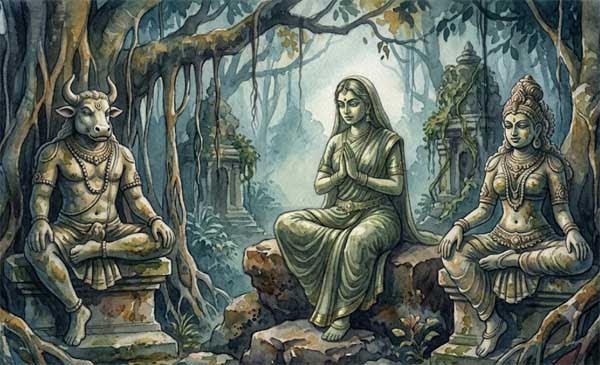
Karana, extend this figure into a small iconographic family. Seated beside
Alakshmi or Nirrti are two attendant figures, a son to her right and a daughter
to her left, both shown in utkutikasana, the posture with one leg folded and
the other resting downward, a stance often used in temple art for minor or
attendant divinities rather than principal deities. The son, called Vrishasya,
is depicted with the face of a bull, two-armed, sober and unadorned. The
daughter is shown with a pleasing countenance, richly bedecked with ornaments,
yet she too carries the inherited nature of her mother.
Symbolism of the Bull-Faced Son
The bull face of Vrishasya is not incidental. In Hindu
symbolism the bull represents dharma itself, often depicted as Nandi or as the
four-legged bull of righteousness in the Puranas, each leg representing truth,
purity, compassion, and charity. By placing a bull-faced figure as the son of
misfortune, the sculptors convey a deep philosophical idea: even adversity
gives rise to endurance and steadfastness. The bull-faced son can be read as
strength born out of hardship, the resilience that misfortune itself produces
when faced with patience.
Symbolism of the Ornamented Daughter
The daughter’s beauty and ornamentation stand in deliberate
contrast to her mother’s inauspicious nature. This is a caution embedded in
stone, that misfortune frequently arrives disguised as attraction, temptation,
or apparent gain. Excessive adornment in Hindu iconography often signals maya,
the illusory pull of the material world. As the daughter of Nirrti, her
loveliness warns the observer that not everything glittering leads to genuine
prosperity.
Philosophy and Importance
Hindu cosmology consistently pairs opposites: Lakshmi and
Alakshmi, Shri and Jyeshtha, order and dissolution. The presence of Alakshmi’s
children in temple sculpture reinforces that misfortune is not a stray accident
but a structured, even generative force within creation, capable of producing
both fortitude, seen in the son, and illusion, seen in the daughter. The
Taittiriya Brahmana and Shatapatha Brahmana likewise treat Nirrti as a power to
be ritually propitiated and directed away from the household rather than one
that can be wished out of existence.
Modern Relevance and Life Lessons
For a contemporary reader, this iconography offers a
practical teaching. Hardship, like the bull-faced son, can be met with dharmic
steadiness, turning difficulty into character. Superficial gain, like the
ornamented daughter, should be examined carefully before it is welcomed, since
attractive circumstances are not always beneficial ones. The family of Alakshmi
ultimately teaches discernment: to recognise when adversity is strengthening us
and when apparent good fortune is merely decorated misfortune.
The son and daughter of Alakshmi are rarely depicted, yet
where they appear, they complete a profound theological statement. Misfortune,
in Hindu thought, is neither ignored nor demonised outright; it is given form,
family, and function, reminding devotees that even the goddess of adversity has
a place within the ordered universe, and that her children mirror the two faces
every hardship wears, endurance and illusion.